


How to Cut Gate Entry Time at Indian Events by 70% (A Field Guide)
If you’ve ever run a gate at an Indian event, you know the moment. Doors are meant to open at 6. By 6:15 the line is three hundred people deep, a scanner has frozen because the venue WiFi just died, and somewhere in that crowd is one person holding tickets for their entire group of eight — who haven’t arrived yet.
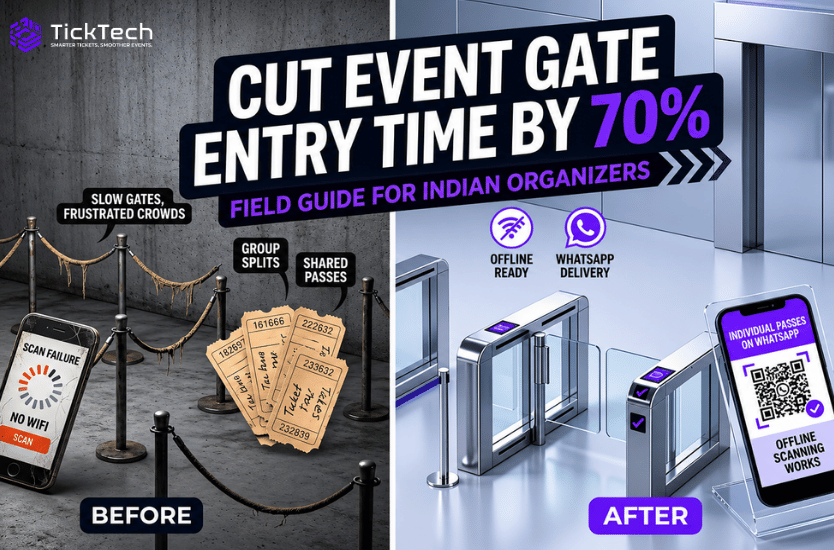
None of this is bad luck. Slow gates are the predictable sum of four specific, avoidable delays. Remove them and entry stops being the worst part of your event. The 70% in the title isn’t a magic number — it’s roughly what you get back when you stop losing time to scan failures, group bottlenecks, re-entry confusion and shared passes. This is a field guide to doing exactly that, and to genuinely reduce event gate entry time without throwing more staff at the problem.
Why Indian event gates jam
Three things make Indian gates harder than the festival-ops playbooks written for Western venues admit.
First, arrival is spiky. People don’t trickle in over an hour; they show up in a wall right after the headline act’s call time or the moment the gates are rumoured to be open. Your throughput has to survive the surge, not the average.
Second, connectivity is unreliable exactly where you need it most. Large outdoor venues, grounds and farmhouses on the edge of a city are precisely the places where mobile data crawls and the venue network buckles under a few thousand phones. A ticketing system that needs the internet to validate a ticket will fail at the worst possible second.
Third, we attend in groups. Friends, families and colleagues book together, travel together and expect to enter together — but rarely arrive at the same time. One booking, one QR, eight people: that is a structural traffic jam waiting to happen.
Layer on the fact that most organizers have no working re-entry policy, and you get gates that move at a fraction of their possible speed. The good news is that each of these is fixable, and the fixes stack.
The four bottlenecks that actually cost you time
Before the fixes, name the enemy. Almost every slow gate in India is some combination of these four event queue bottlenecks.
Scan failures
The scanner depends on a live internet connection to check a ticket against a server. Connectivity drops during the rush, the app spins, and the line stops dead. Even a few seconds of hesitation per scan, multiplied across a surge, turns into a queue that snakes out to the road.
Group splits
A group buys one combined ticket. The person carrying it arrives, but the rest of the group is parking, eating or stuck in traffic. The gate can’t admit anyone until the whole party is reunited at the entrance — so they all wait, and so does everyone behind them.
Re-entry chaos
Someone steps out for a smoke, their car or food. With no system tracking who left and whether they’re allowed back, staff either wave people through and lose all control, or argue at the gate over double-entry. Both kill flow.
Late arrivals on a shared pass
Closely related to group splits but worse: the whole group is riding a single QR code that’s been screenshotted and forwarded around WhatsApp. Now the gate is fielding multiple people presenting the same code, and staff have to manually sort out who is legitimate.
Tactical fixes, bottleneck by bottleneck
Here’s how to dismantle each one. None of these require more staff — they require the right setup.
Fix scan failures with offline-first scanning
Stop treating internet as a requirement and start treating it as a bonus. An offline-first scanner validates tickets against data already on the device and syncs in the background whenever a connection is available. Gates keep moving even when the network is completely down, and you reconcile everything once you’re back online.
Pair it with a manual-entry fallback for the rare edge case — a damaged code, a dead phone battery on the attendee’s side — so a single problem ticket never stalls the lane. The principle is simple: nothing at the gate should ever wait on a signal.
Fix group splits with individual passes
The cure for group bottlenecks is to break the group booking into individual passes before anyone reaches the gate. A group leader buys for eight, then splits and shares a separate pass to each person, sent directly to their own phone. Now each attendee enters on their own QR the moment they arrive, whether that’s together or spread across two hours. No one waits for anyone.
This single change quietly removes one of the largest sources of gate congestion, because it converts your slowest unit of entry — a group that must assemble — into your fastest: individuals arriving on their own schedule.
Fix re-entry with controlled validity
Re-entry isn’t the problem; uncontrolled re-entry is. Give each pass a defined validity and let the system track exits and returns, so a scan tells your staff not just “valid ticket” but “this person already entered and is allowed back.” You decide whether re-entry is on, for whom, and within what window. Staff stop adjudicating disputes at the gate because the scanner already knows the answer.
Fix shared passes with a controlled QR release
The reason one QR ends up forwarded to a dozen people is that the code is available the moment the ticket is bought, with weeks to circulate. Delay it. A controlled-release QR stays hidden until a date and time you set — typically shortly before the event — so there’s nothing to screenshot and forward early. Combined with individual passes, every person at your gate is presenting a unique, recently-revealed code, and the “same QR, five people” problem disappears.
Tech choices that actually matter
When you’re evaluating a ticketing platform, most feature lists are noise. For gate speed specifically, these are the things worth checking.
- Offline scanning. Non-negotiable for any outdoor or large venue in India. Ask whether validation genuinely works with no connection, or whether “offline mode” just means a degraded experience.
- Sub-second verification. The per-scan delay is what compounds during a surge. Fast, reliable QR confirmation is the difference between a moving lane and a stalled one.
- WhatsApp-native delivery. This is where India diverges hard from the email-first West. Email open rates in India sit far below messaging apps, while WhatsApp open rates are near-universal. Delivering the e-pass as a PDF straight to WhatsApp — no app to download, no inbox to dig through — means attendees actually have their ticket ready when they reach the gate, instead of hunting for it in line.
- Per-attendee QR and re-entry tracking. Confirm that passes are individual by default and that the system logs entries and exits. These two are what make the group-split and re-entry fixes above actually work.
A platform that does these four things well will move a gate faster than any amount of extra staff thrown at the problem. TickTech was built around exactly this combination — see how offline scanning and WhatsApp delivery work together at the gate.
Stop firefighting your own gate
You shouldn’t have to spend your event day standing at the entrance solving problems that better tooling would have prevented. The four bottlenecks above are solved problems — the only question is whether your platform actually solves them.
Book a demo and let us handle the gate headache.
Show us your next event and we’ll set up offline scanning, individual WhatsApp passes, controlled QR release and re-entry tracking with you — so entry just works while you focus on the show.
Get a demo →